BMW Ads: How “The Ultimate Driving Machine” Became an All-Time Icon
12
min read
Mike Ward
Creative director and car guy, I design unique auto show boards and t-shirts inspired by vintage car ads.
If you’re reading this, you’ve probably heard someone say it—maybe at a meet, maybe while defending their questionable tire budget: “BMW is the Ultimate Driving Machine.” And if you’re into advertising, you’ve definitely studied it. That phrase isn’t just a tagline. It’s a north star BMW used for decades to keep its marketing (especially its print advertisements) sharp, consistent, and instantly recognizable.
So why do BMW print ads hit different? Why did this campaign become one of the most iconic auto ads of all time, right up there with the greats? And how did a few pages in magazines help turn BMW into a performance-luxury benchmark in the minds of drivers?
Let’s dig in—car-nerd style, but with a creative director’s eye.
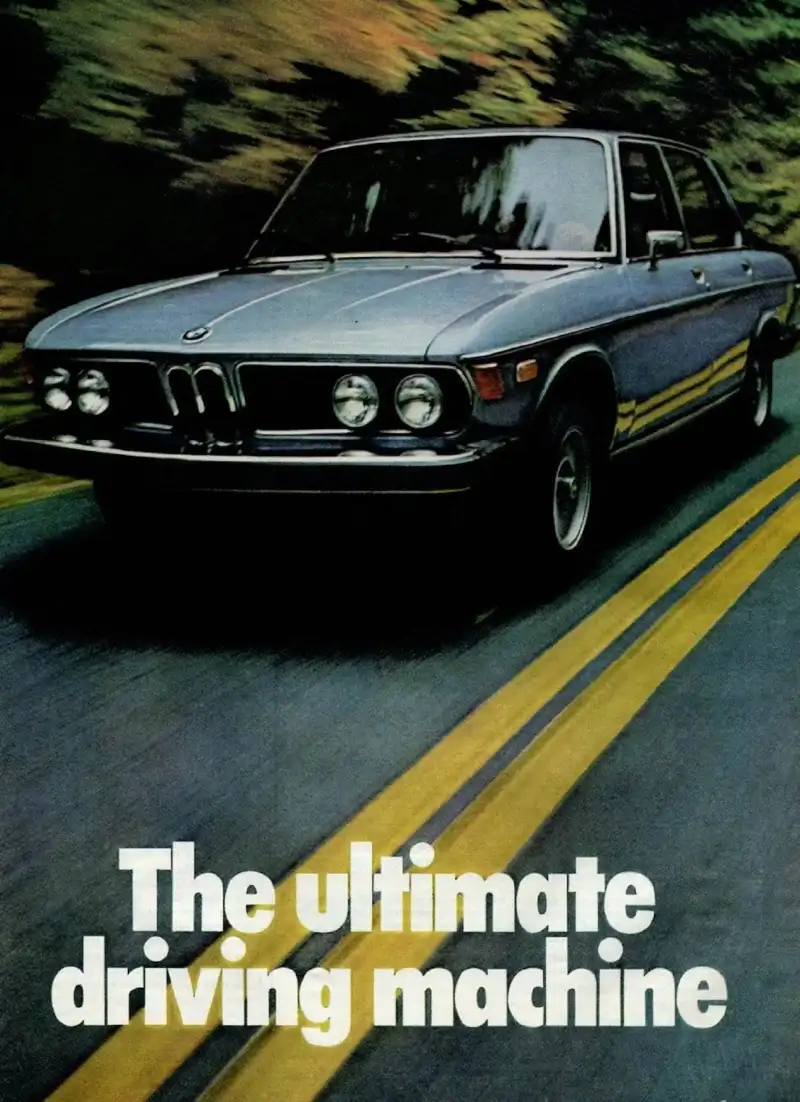
The Original Ultimate Driving machine vintage car ad.
Introduction: The quiet power of ink on paper
There’s something almost romantic about print ads for cars. No autoplay videos, no skippable pre-roll, no algorithm deciding if you deserve to see the good stuff. Just a page, a photo, a headline, and a promise. And BMW, more than most automakers, learned how to make that page feel like a steering wheel in your hands.
BMW’s classic print advertising didn’t try to be everything to everyone. It didn’t sell “status” first. It sold the feeling of driving—that moment when a car rotates neatly into a corner and you think, Oh. This is what they meant.
And the genius is: the ads made you feel that… while sitting still.
The origin story: where “The Ultimate Driving Machine” actually came from
“The Ultimate Driving Machine” slogan was coined in 1974 by Martin Puris, created for BMW advertising in the U.S. during the era associated with the agency Ammirati & Puris. The campaign was designed to establish a unique brand identity in the US market, shifting from the previous "For the Joy of Driving" (1965–1972) tagline. That’s not trivia—that’s the starting line for a brand idea that would shape decades of BMW marketing.
BMW itself has discussed this history in its brand and advertising retrospectives, including BMW Group press material, and the campaign is also documented in archival/educational collections like St. John’s University’s Ammirati & Puris archive pages.
Why does that matter? Because it tells you the slogan wasn’t some random late-night brainstorm. It was a deliberate positioning move at a moment when BMW was still building its American identity. The line wasn’t only meant to sound cool—it was meant to plant a flag: We’re not a luxury car. We’re a driver’s car that happens to be premium.
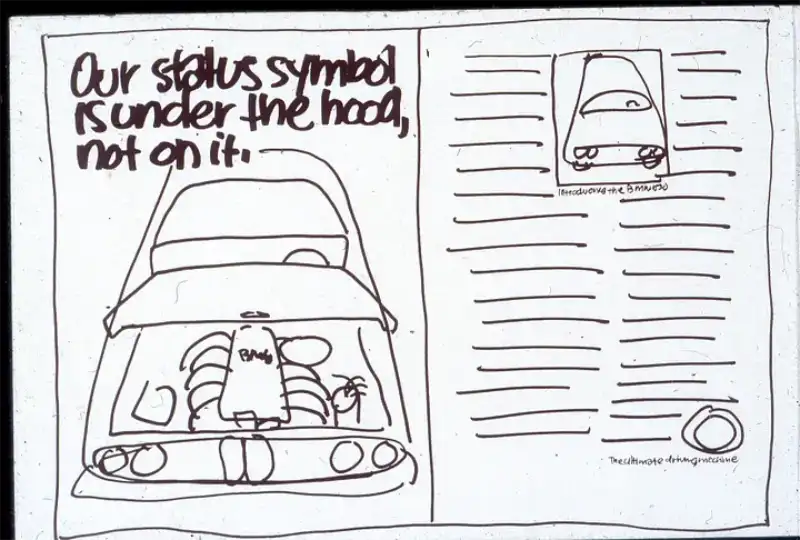
Original layout for BMW print ad by legendary advertising agency Ammirati & Puris
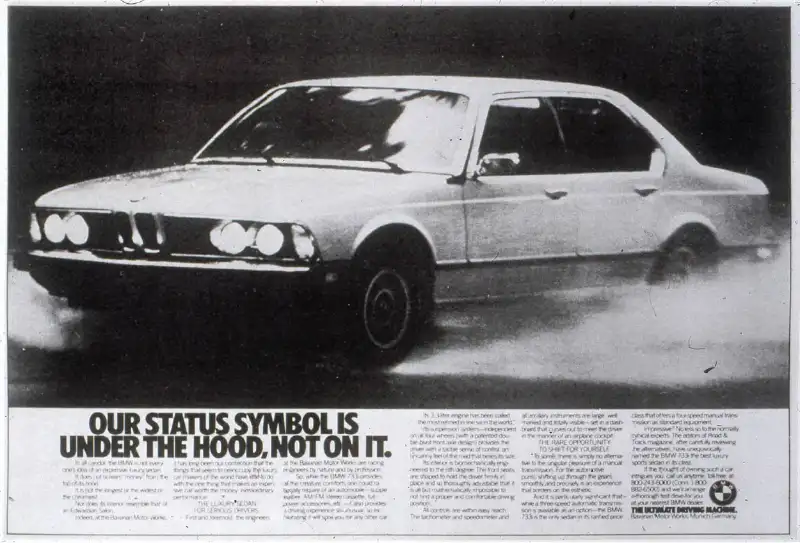
How the BMW print ad actually ran in publications. Note the long copy, which was active reading and made Ammirati & Puris copywriters Marty Puris and Joe O’Neill famous.
The look and feel: what BMW print ads “sound like” visually
BMW’s best print ads have a signature vibe. Even if the layout changed across decades, the design language stayed remarkably consistent.
1) Clean layouts that respect your attention
A lot of classic automotive print advertising screams at you—big type, big scenery, big emotions. BMW often did the opposite:
A strong hero image of the car (sometimes moving, sometimes poised)
Space to breathe
A headline that feels confident, not desperate
Copy that doesn’t treat you like you’re half-asleep
That “restraint” is a flex. It’s like a tailored suit: the less it needs to shout, the more you assume it’s expensive.
2) Photography that implies motion—even when parked
Great BMW print ads tend to show cars in situations that suggest driving purpose:
Roads that curve
A stance that looks ready
Angles that highlight balance and proportion
Even when the car is stationary, the ad composition hints at kinetic energy, like a sprinter frozen mid-warmup.
3) Typography and tone that feel engineered
The type choices and grid discipline often mirror what BMW wanted you to believe about its cars: precise, Germanic, intentional. Whether you’re looking at a 3 Series-era magazine spread or a later premium placement, you can feel the control.
And that’s the point: BMW print ads aren’t just pretty—they’re designed to feel like the product.
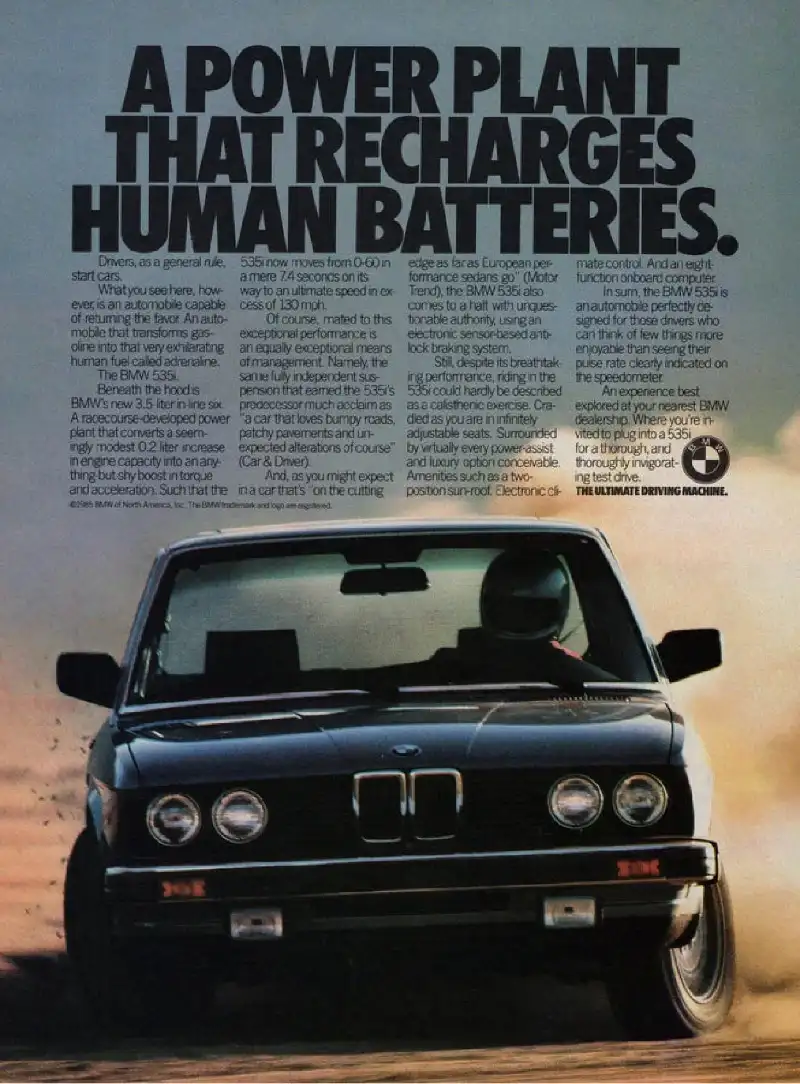
Vintage auto ad: BMW, A Power Plant That Recharges Human Batteries.
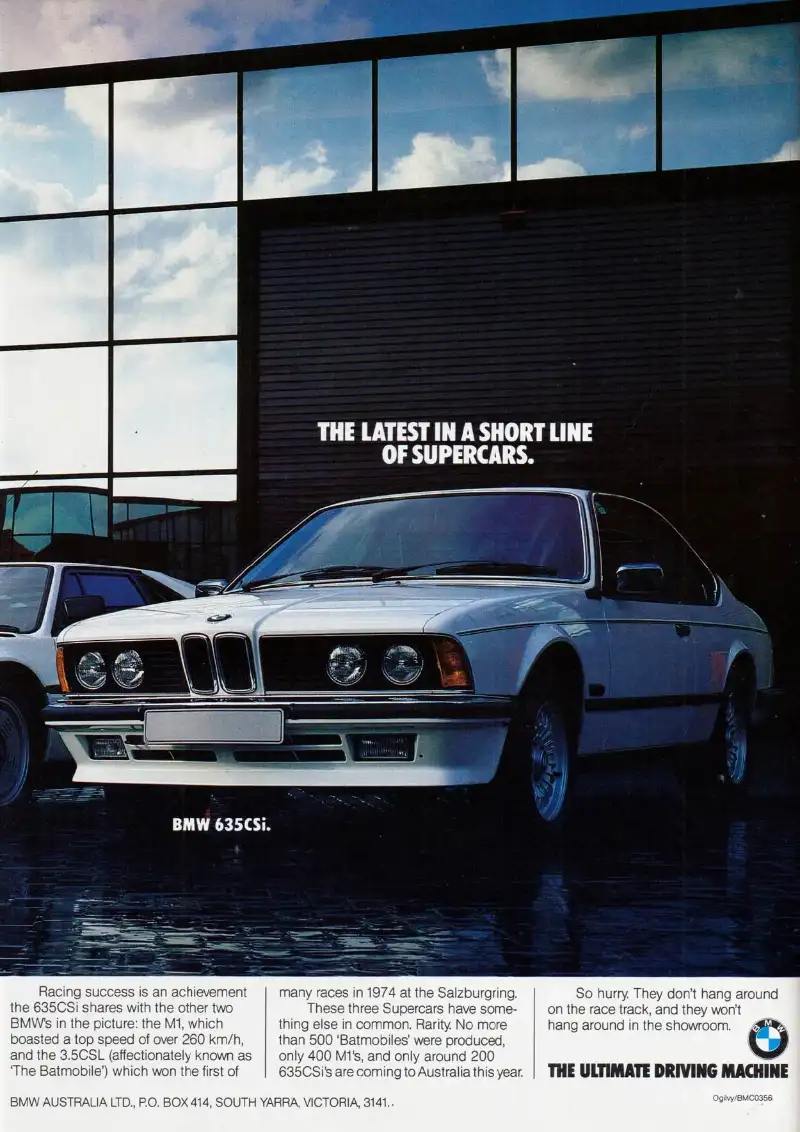
Vintage auto ad: BMW, The Latest in a Short Line of Supercars.
The big idea: selling the driver, not the driver’s neighbors
Here’s the core move that made BMW’s print campaign legendary:
BMW didn’t primarily sell transportation or status. BMW sold identity: “I drive.”
That might sound obvious now because every brand wants to be “driver-focused.” But BMW helped write the modern playbook for that positioning.
Driver-first positioning (the real hook)
The campaign implied a simple worldview:
Some people want a car as a symbol.
Some people want a car as a tool.
Some people want a car as an instrument.
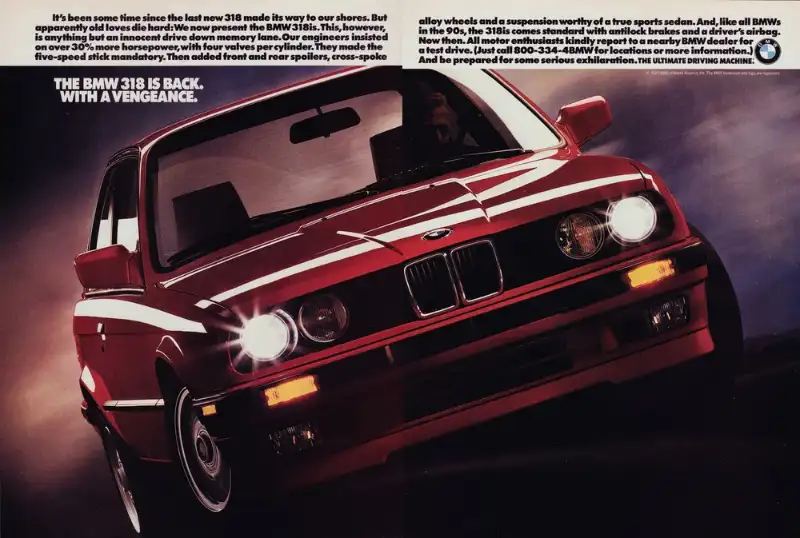
Vintage auto ad: The BMW 318 is Back with a Vengeance
BMW’s ads spoke to that last group. The ones who notice steering feel. The ones who take the long way home. The ones who understand that a well-tuned chassis is basically a love letter written in physics.
If you’ve ever chosen a route based on corners instead of traffic, you already understand the campaign.
Why the tagline is so powerful: a slogan that behaves like a product spec
“The Ultimate Driving Machine” works because it’s built like a great piece of engineering—simple on the outside, loaded with meaning underneath.
1) It’s specific enough to own
It doesn’t say “ultimate luxury.” It doesn’t say “ultimate technology.” It says driving.
That one word is the fence around the territory BMW wanted to claim. And it’s hard for competitors to steal a claim when you’ve already planted it that cleanly.
2) It’s bold—but testable
“Ultimate” is a big word. Big words are dangerous in advertising… unless the product can back it up.
This is where BMW print ads did their job: they repeatedly supplied the proof points—handling, balance, driver involvement, performance cues—so the superlative didn’t feel like fluff. It felt like a conclusion you arrived at yourself.
3) It turns customers into a tribe
A tagline like this does something sneaky: it makes the buyer feel like they’re not just purchasing a car, they’re joining a club.
And what’s the membership requirement? Not income. Not social status. It’s taste—specifically, taste for driving.
That’s powerful brand alchemy. It transforms a vehicle into a personality mirror.
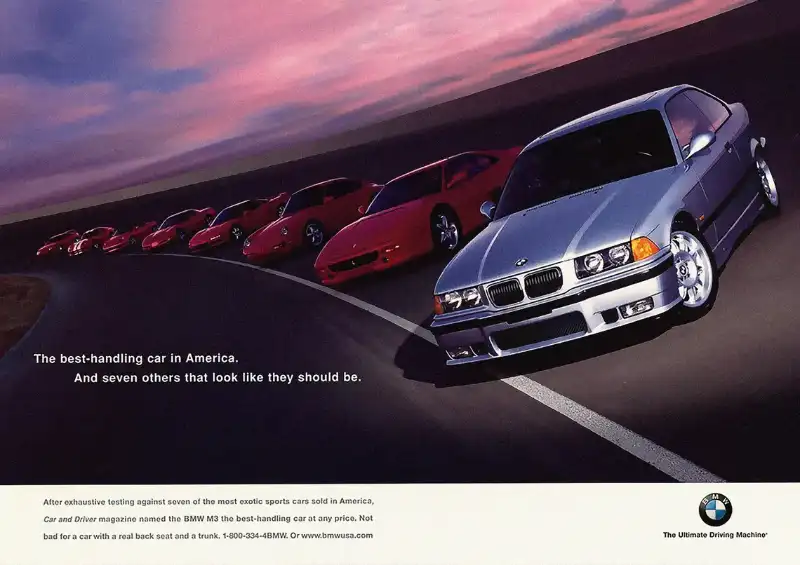
Vintage auto ad: BMW, The Best Handling Car in America, and Seven Others that Look Like They Should Be.
How BMW print work actually sold cars (without sounding like it was selling)
Let’s talk about mechanics—advertising mechanics, not valve timing.
BMW’s print ads weren’t just clever. They were effective, because they connected emotional desire to rational justification in a way that felt natural.
1) They led with emotion, then paid it off with logic
A great car ad often needs two gears:
Gear 1: Desire (This makes me feel something.)
Gear 2: Reason (Here’s why it’s not a dumb decision.)
BMW print ads typically opened with a strong image and a crisp headline—then used body copy to reinforce engineering credibility. That’s a classic one-two punch: heart first, brain second.
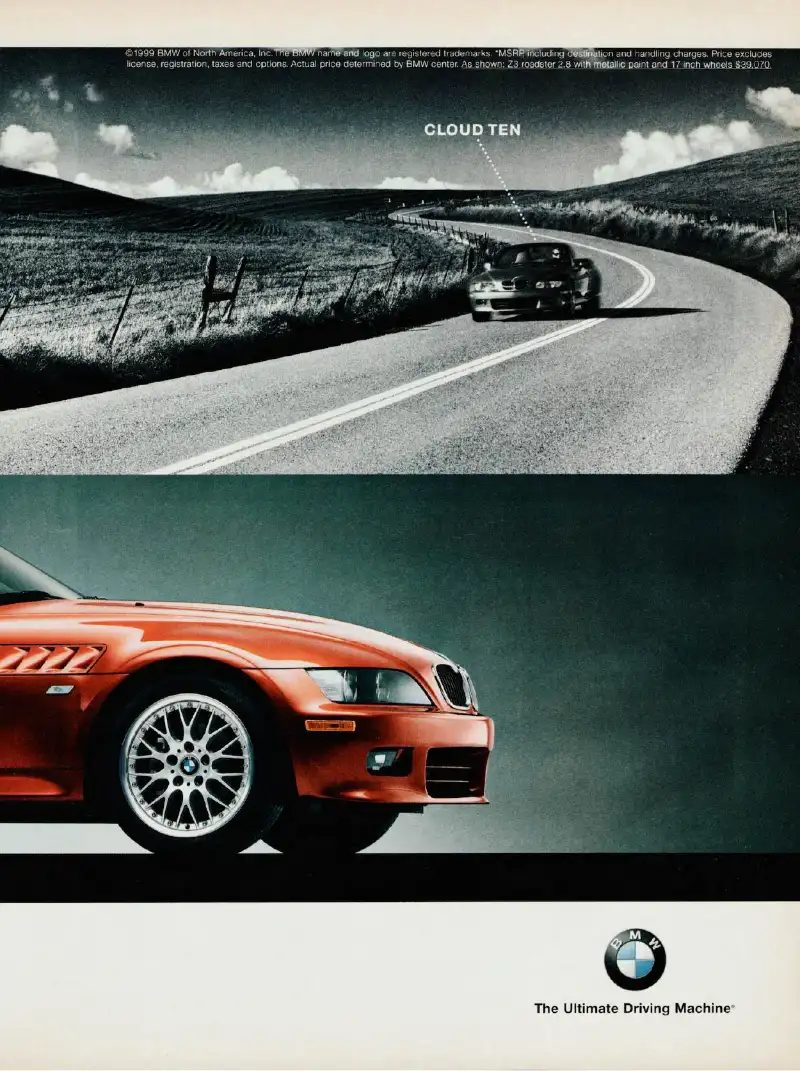
Vintage auto ad: BMW, Cloud Ten.
2) They treated the reader like a smart enthusiast
This is huge. Some ads talk down to people. BMW’s better print campaigns talked with you.
They didn’t need to do circus tricks. They didn’t need to over-explain. They assumed you cared about:
How it drives
How it’s built
Why it feels different
That respectful tone is part of why the ads aged well. They don’t feel like artifacts of a gimmicky era. They feel like conversations with people who actually like cars.
3) They made “premium” mean “performance,” not “plush”
A lot of luxury advertising historically focused on isolation: quiet cabins, soft seats, floating rides. BMW print ads often leaned into the opposite: connection.
It’s the difference between:
“You won’t feel the road” and
“You’ll feel everything you want to feel—and none of what you don’t.”
That framing helped BMW own the performance-luxury lane: comfort and quality, yes, but always in service of the driver.
4) They reinforced resale value—without saying “resale value”
When a brand consistently positions itself around engineering and driving excellence, it quietly builds another asset: perceived durability and long-term value.
Even if an ad doesn’t mention reliability directly, the implication of careful design and performance integrity can make buyers feel safer spending more. It’s like buying a chef’s knife instead of a bargain set—you’re paying for the confidence that it’ll do the job right.
Why creatives call it one of the most iconic auto ad ideas ever
From a creative director’s perspective, BMW’s “Ultimate Driving Machine” print era is a masterclass because it nails the three things iconic campaigns always nail:
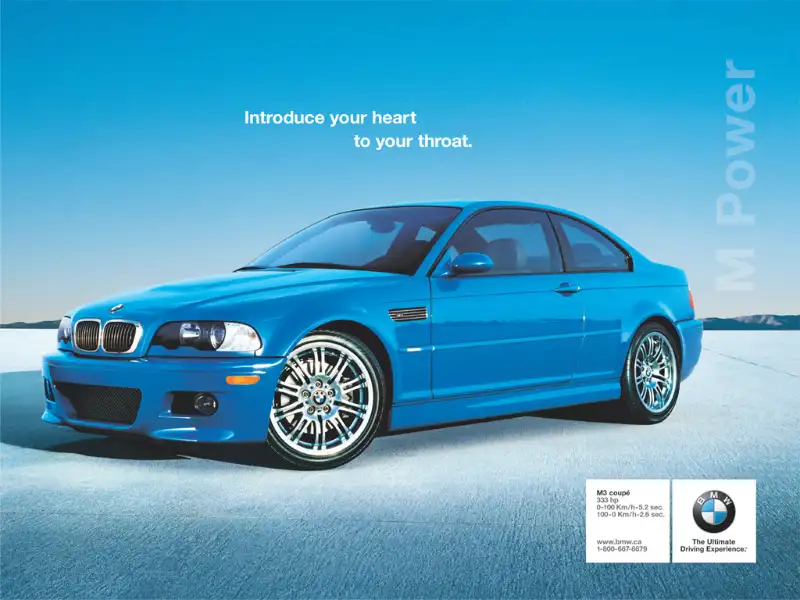
Vintage auto ad: BMW, Introduce your heart to your throat.
1) One clear idea, repeated with discipline
Iconic campaigns aren’t a collection of random great ads. They’re a consistent story told from different angles.
BMW kept coming back to the same promise: driving engagement. That consistency builds memory structures in people’s minds. You don’t just remember an ad—you remember what the brand stands for.
2) The message matches the product truth
The best advertising doesn’t invent a personality. It reveals one.
BMW didn’t have to pretend to be driver-focused; it could credibly claim it and repeatedly show evidence. When the ad promise and product experience align, loyalty gets sticky.
3) It created a benchmark competitors had to respond to
A campaign becomes legendary when it forces the entire category to evolve.
Once BMW owned “driving machine,” competitors had to answer a difficult question: If BMW is for drivers, what are we?
That’s when you see other brands pivot their messaging toward handling, sport trims, road feel, performance heritage—because BMW made driving credibility a premium-brand requirement.
The influence: how BMW print advertising rewired modern car marketing
BMW didn’t just sell cars. It helped change what people expected from car ads, especially in the premium space.
1) It helped popularize “driver-centric” premium branding
Today, nearly every luxury automaker claims some version of performance DNA. That’s not an accident.
BMW’s consistent print messaging helped mainstream the idea that a premium sedan could be:
refined and athletic
practical and thrilling
upscale and obsessed with handling
2) It showed that technical copy can still be persuasive
There’s a myth that people don’t read. In reality, people don’t read boring things.
BMW print ads often gave readers just enough engineering talk—balanced with tone and clarity—to make them feel informed, not overwhelmed. It proved you can use smart copy as a selling tool, not just decoration.
3) It set a template for long-running automotive taglines
Few car taglines have lasted in culture the way this one has. Even people who don’t own BMWs know the phrase.
That’s the holy grail: when a line becomes part of language, it stops being “marketing” and starts being brand myth.
4) It influenced enthusiast media and mainstream perception at the same time
Print placements in car magazines, lifestyle publications, and business outlets allowed BMW to speak to multiple audiences without changing the core message.
Enthusiasts heard: handling, balance, driver feel. Aspirational buyers heard: taste, quality, confident choice. And BMW managed to say both with one line.
That’s rare.
What made BMW print ads feel “human,” not corporate
Here’s the secret sauce that people miss when they only analyze layout and taglines:
BMW’s best print advertising often had a slightly conversational confidence. It didn’t beg you to buy. It nudged you like a friend who knows you’ll appreciate the details.
And that tone matters. Because the buyer BMW wanted—the one who cares about driving—doesn’t want to feel sold. They want to feel understood.
So BMW’s print ads often behaved like this:
They invite you to notice something.
They assume you’ll get it.
They let you reach the conclusion.
That’s not just good writing. That’s good psychology.
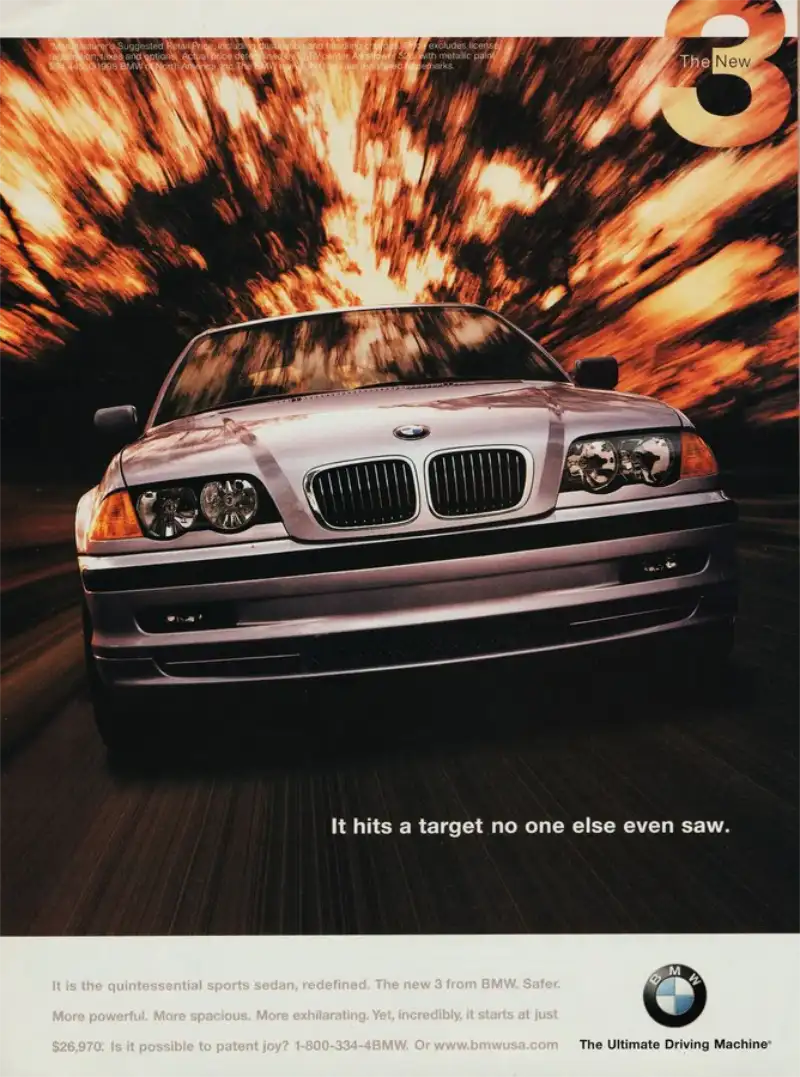
Vintage auto ad: BMW, It hits a target no one else even saw.
Conclusion: Why “The Ultimate Driving Machine” still matters
BMW’s “The Ultimate Driving Machine” isn’t just one of the most iconic auto ads of all time because it’s catchy—though it is. It’s iconic because it compressed a whole brand philosophy into five words, then used print advertising to prove that philosophy again and again with discipline, clarity, and confidence.
Coined in 1974 by Martin Puris, the line became a cultural shortcut for a specific promise: BMW builds cars for people who actually enjoy driving. And BMW’s print ads—clean, smart, driver-focused—made that promise feel real long before you ever touched the steering wheel.
That’s the magic. A great print ad doesn’t just show you a car. It makes you feel the road.
If you’re reading this, you’ve probably heard someone say it—maybe at a meet, maybe while defending their questionable tire budget: “BMW is the Ultimate Driving Machine.” And if you’re into advertising, you’ve definitely studied it. That phrase isn’t just a tagline. It’s a north star BMW used for decades to keep its marketing (especially its print advertisements) sharp, consistent, and instantly recognizable.
So why do BMW print ads hit different? Why did this campaign become one of the most iconic auto ads of all time, right up there with the greats? And how did a few pages in magazines help turn BMW into a performance-luxury benchmark in the minds of drivers?
Let’s dig in—car-nerd style, but with a creative director’s eye.
The Original Ultimate Driving machine vintage car ad.
Introduction: The quiet power of ink on paper
There’s something almost romantic about print ads for cars. No autoplay videos, no skippable pre-roll, no algorithm deciding if you deserve to see the good stuff. Just a page, a photo, a headline, and a promise. And BMW, more than most automakers, learned how to make that page feel like a steering wheel in your hands.
BMW’s classic print advertising didn’t try to be everything to everyone. It didn’t sell “status” first. It sold the feeling of driving—that moment when a car rotates neatly into a corner and you think, Oh. This is what they meant.
And the genius is: the ads made you feel that… while sitting still.
The origin story: where “The Ultimate Driving Machine” actually came from
“The Ultimate Driving Machine” slogan was coined in 1974 by Martin Puris, created for BMW advertising in the U.S. during the era associated with the agency Ammirati & Puris. The campaign was designed to establish a unique brand identity in the US market, shifting from the previous "For the Joy of Driving" (1965–1972) tagline. That’s not trivia—that’s the starting line for a brand idea that would shape decades of BMW marketing.
BMW itself has discussed this history in its brand and advertising retrospectives, including BMW Group press material, and the campaign is also documented in archival/educational collections like St. John’s University’s Ammirati & Puris archive pages.
Why does that matter? Because it tells you the slogan wasn’t some random late-night brainstorm. It was a deliberate positioning move at a moment when BMW was still building its American identity. The line wasn’t only meant to sound cool—it was meant to plant a flag: We’re not a luxury car. We’re a driver’s car that happens to be premium.
Original layout for BMW print ad by legendary advertising agency Ammirati & Puris
How the BMW print ad actually ran in publications. Note the long copy, which was active reading and made Ammirati & Puris copywriters Marty Puris and Joe O’Neill famous.
The look and feel: what BMW print ads “sound like” visually
BMW’s best print ads have a signature vibe. Even if the layout changed across decades, the design language stayed remarkably consistent.
1) Clean layouts that respect your attention
A lot of classic automotive print advertising screams at you—big type, big scenery, big emotions. BMW often did the opposite:
A strong hero image of the car (sometimes moving, sometimes poised)
Space to breathe
A headline that feels confident, not desperate
Copy that doesn’t treat you like you’re half-asleep
That “restraint” is a flex. It’s like a tailored suit: the less it needs to shout, the more you assume it’s expensive.
2) Photography that implies motion—even when parked
Great BMW print ads tend to show cars in situations that suggest driving purpose:
Roads that curve
A stance that looks ready
Angles that highlight balance and proportion
Even when the car is stationary, the ad composition hints at kinetic energy, like a sprinter frozen mid-warmup.
3) Typography and tone that feel engineered
The type choices and grid discipline often mirror what BMW wanted you to believe about its cars: precise, Germanic, intentional. Whether you’re looking at a 3 Series-era magazine spread or a later premium placement, you can feel the control.
And that’s the point: BMW print ads aren’t just pretty—they’re designed to feel like the product.
Vintage auto ad: BMW, A Power Plant That Recharges Human Batteries.
Vintage auto ad: BMW, The Latest in a Short Line of Supercars.
The big idea: selling the driver, not the driver’s neighbors
Here’s the core move that made BMW’s print campaign legendary:
BMW didn’t primarily sell transportation or status. BMW sold identity: “I drive.”
That might sound obvious now because every brand wants to be “driver-focused.” But BMW helped write the modern playbook for that positioning.
Driver-first positioning (the real hook)
The campaign implied a simple worldview:
Some people want a car as a symbol.
Some people want a car as a tool.
Some people want a car as an instrument.
Vintage auto ad: The BMW 318 is Back with a Vengeance
BMW’s ads spoke to that last group. The ones who notice steering feel. The ones who take the long way home. The ones who understand that a well-tuned chassis is basically a love letter written in physics.
If you’ve ever chosen a route based on corners instead of traffic, you already understand the campaign.
Why the tagline is so powerful: a slogan that behaves like a product spec
“The Ultimate Driving Machine” works because it’s built like a great piece of engineering—simple on the outside, loaded with meaning underneath.
1) It’s specific enough to own
It doesn’t say “ultimate luxury.” It doesn’t say “ultimate technology.” It says driving.
That one word is the fence around the territory BMW wanted to claim. And it’s hard for competitors to steal a claim when you’ve already planted it that cleanly.
2) It’s bold—but testable
“Ultimate” is a big word. Big words are dangerous in advertising… unless the product can back it up.
This is where BMW print ads did their job: they repeatedly supplied the proof points—handling, balance, driver involvement, performance cues—so the superlative didn’t feel like fluff. It felt like a conclusion you arrived at yourself.
3) It turns customers into a tribe
A tagline like this does something sneaky: it makes the buyer feel like they’re not just purchasing a car, they’re joining a club.
And what’s the membership requirement? Not income. Not social status. It’s taste—specifically, taste for driving.
That’s powerful brand alchemy. It transforms a vehicle into a personality mirror.
Vintage auto ad: BMW, The Best Handling Car in America, and Seven Others that Look Like They Should Be.
How BMW print work actually sold cars (without sounding like it was selling)
Let’s talk about mechanics—advertising mechanics, not valve timing.
BMW’s print ads weren’t just clever. They were effective, because they connected emotional desire to rational justification in a way that felt natural.
1) They led with emotion, then paid it off with logic
A great car ad often needs two gears:
Gear 1: Desire (This makes me feel something.)
Gear 2: Reason (Here’s why it’s not a dumb decision.)
BMW print ads typically opened with a strong image and a crisp headline—then used body copy to reinforce engineering credibility. That’s a classic one-two punch: heart first, brain second.
Vintage auto ad: BMW, Cloud Ten.
2) They treated the reader like a smart enthusiast
This is huge. Some ads talk down to people. BMW’s better print campaigns talked with you.
They didn’t need to do circus tricks. They didn’t need to over-explain. They assumed you cared about:
How it drives
How it’s built
Why it feels different
That respectful tone is part of why the ads aged well. They don’t feel like artifacts of a gimmicky era. They feel like conversations with people who actually like cars.
3) They made “premium” mean “performance,” not “plush”
A lot of luxury advertising historically focused on isolation: quiet cabins, soft seats, floating rides. BMW print ads often leaned into the opposite: connection.
It’s the difference between:
“You won’t feel the road” and
“You’ll feel everything you want to feel—and none of what you don’t.”
That framing helped BMW own the performance-luxury lane: comfort and quality, yes, but always in service of the driver.
4) They reinforced resale value—without saying “resale value”
When a brand consistently positions itself around engineering and driving excellence, it quietly builds another asset: perceived durability and long-term value.
Even if an ad doesn’t mention reliability directly, the implication of careful design and performance integrity can make buyers feel safer spending more. It’s like buying a chef’s knife instead of a bargain set—you’re paying for the confidence that it’ll do the job right.
Why creatives call it one of the most iconic auto ad ideas ever
From a creative director’s perspective, BMW’s “Ultimate Driving Machine” print era is a masterclass because it nails the three things iconic campaigns always nail:
Vintage auto ad: BMW, Introduce your heart to your throat.
1) One clear idea, repeated with discipline
Iconic campaigns aren’t a collection of random great ads. They’re a consistent story told from different angles.
BMW kept coming back to the same promise: driving engagement. That consistency builds memory structures in people’s minds. You don’t just remember an ad—you remember what the brand stands for.
2) The message matches the product truth
The best advertising doesn’t invent a personality. It reveals one.
BMW didn’t have to pretend to be driver-focused; it could credibly claim it and repeatedly show evidence. When the ad promise and product experience align, loyalty gets sticky.
3) It created a benchmark competitors had to respond to
A campaign becomes legendary when it forces the entire category to evolve.
Once BMW owned “driving machine,” competitors had to answer a difficult question: If BMW is for drivers, what are we?
That’s when you see other brands pivot their messaging toward handling, sport trims, road feel, performance heritage—because BMW made driving credibility a premium-brand requirement.
The influence: how BMW print advertising rewired modern car marketing
BMW didn’t just sell cars. It helped change what people expected from car ads, especially in the premium space.
1) It helped popularize “driver-centric” premium branding
Today, nearly every luxury automaker claims some version of performance DNA. That’s not an accident.
BMW’s consistent print messaging helped mainstream the idea that a premium sedan could be:
refined and athletic
practical and thrilling
upscale and obsessed with handling
2) It showed that technical copy can still be persuasive
There’s a myth that people don’t read. In reality, people don’t read boring things.
BMW print ads often gave readers just enough engineering talk—balanced with tone and clarity—to make them feel informed, not overwhelmed. It proved you can use smart copy as a selling tool, not just decoration.
3) It set a template for long-running automotive taglines
Few car taglines have lasted in culture the way this one has. Even people who don’t own BMWs know the phrase.
That’s the holy grail: when a line becomes part of language, it stops being “marketing” and starts being brand myth.
4) It influenced enthusiast media and mainstream perception at the same time
Print placements in car magazines, lifestyle publications, and business outlets allowed BMW to speak to multiple audiences without changing the core message.
Enthusiasts heard: handling, balance, driver feel. Aspirational buyers heard: taste, quality, confident choice. And BMW managed to say both with one line.
That’s rare.
What made BMW print ads feel “human,” not corporate
Here’s the secret sauce that people miss when they only analyze layout and taglines:
BMW’s best print advertising often had a slightly conversational confidence. It didn’t beg you to buy. It nudged you like a friend who knows you’ll appreciate the details.
And that tone matters. Because the buyer BMW wanted—the one who cares about driving—doesn’t want to feel sold. They want to feel understood.
So BMW’s print ads often behaved like this:
They invite you to notice something.
They assume you’ll get it.
They let you reach the conclusion.
That’s not just good writing. That’s good psychology.
Vintage auto ad: BMW, It hits a target no one else even saw.
Conclusion: Why “The Ultimate Driving Machine” still matters
BMW’s “The Ultimate Driving Machine” isn’t just one of the most iconic auto ads of all time because it’s catchy—though it is. It’s iconic because it compressed a whole brand philosophy into five words, then used print advertising to prove that philosophy again and again with discipline, clarity, and confidence.
Coined in 1974 by Martin Puris, the line became a cultural shortcut for a specific promise: BMW builds cars for people who actually enjoy driving. And BMW’s print ads—clean, smart, driver-focused—made that promise feel real long before you ever touched the steering wheel.
That’s the magic. A great print ad doesn’t just show you a car. It makes you feel the road.
Cruise Night Hero vintage auto ad inspired t-shirts
Looking for t-shirts that showcase your love for cars? Look no further! Check out our collection of classic auto ad inspired t-shirts, new designs added weekly. Show off your style and passion with these unique tees, available now in our store.